BEBPA Blog
Tech Briefing: In‑Person Expertise Matters: Building Depth in HCP Analytics at the 2026 BEBPA HCP Workshop
By Fengqiang Wang (Merck & Co., Inc.), Ying Zhang (Eli Lilly and Company) and Lisette Coye (Coye CMC Strategies)
In an era when AI tools can surface information within seconds, the challenge is no longer access, but the ability to critically evaluate it, interpret it, and place it in the context of real-world analytical challenges. This is especially true in HCP analysis, where no single individual – regardless of expertise – can realistically maintain deep, up-to-date knowledge across all aspects of immunoassay technologies, LC-MS workflows, coverage assessment strategies, regulatory considerations, and emerging modality-specific HCP risks. The breadth and complexity of the field make collective experience essential.
In-person workshops create a unique environment where participants can tap into the combined expertise of multiple industry leaders, share practical lessons learned, and pressure-test certain practices through discussion and debate. These interactions enable deep dives into tailored technical topics, offer newcomers foundational understanding, and provide seasoned experts with a forum to refine best practices.
The 2026 BEBPA in-person HCP Workshop is designed to provide the type of learning that no digital tool can replicate: peer‑to‑peer exchange of knowledge and networking, real life case studies on dealing with problematic HCPs, healthy debate around alternative approaches for problem solving, and collective perspectives on whether USP 1132 should be updated to reflect today’s evolved biopharmaceutical development landscape.
In our workshop titled “From basic analytics to advanced analytical characterization: tackling the “bad actors” for a systematic HCP risk control and exploring opportunities to update USP 1132″, we will cover the following:
1. Building Foundations for Newcomers
For scientists newly entering the field, understanding what HCPs are, why they matter, and how we can detect and measure them is critical. The workshop will walk through some fundamental questions such as:
- What are host cell proteins, and how do they arise during biologics manufacturing?
- Why must we monitor HCPs during development and/or QC release testing?
- How do different analytical methods—ELISA, LC‑MS, and other orthogonal assays—complement one another for HCP detection and measurement?
2. Deep Dives for Experienced Scientists
Beyond the fundamentals, the workshop provides a venue for seasoned HCP scientists to explore advanced analytical characterization that aims to investigate problematic HCPs and discuss evolving best practices. Example topics include:
- HCP dilution linearity challenges and mitigation strategies
- Coverage analysis using either traditional 2D Western blots or LC-MS based techniques
- Technical and practical considerations during method development and validation
3. Regulatory Considerations and Practical Questions the Industry Continues to Debate
The HCP field is evolving rapidly, and not all practices are yet standardized. The workshop will provide open discussion space around questions proposed by the participants through surveys, examples include:
- How should a method developer choose between immunoassay and LC‑MS methods during method development and lifecycle management?
- How would emerging modalities impact the choice of HCP methods, especially those lacking affinity purification steps and therefore carrying higher HCP burdens?
- What activity‑centric approaches are needed to detect and control low‑abundance but high‑risk enzymatically active HCPs?
A key component of this year’s discussion will also include a critical reflection on USP 1132, exploring areas where modern practice on new modality development and product quality control may suggest opportunities for refinement and future updates. Example areas are listed in the following table.
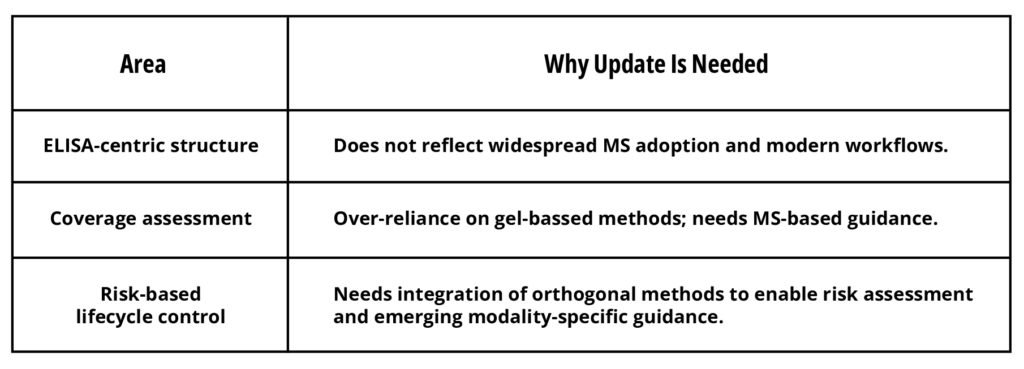
These areas benefit immensely from live technical debate and discussion, something not replicable through documents or search‑based learning. While AI has significantly accelerated information retrieval, it also increases the risk of uncontextualized or oversimplified insights. HCP analytics is a nuanced discipline where the “right” tools depend heavily on the context of application, with each tool having its own strengths and weaknesses. Collectively, a holistic approach that leverages the strengths of each analytical tool and applies them in a fit‑for‑purpose manner will help illuminate the blind spots of other tools, enabling a more complete understanding of HCP risks and control.
We are truly excited about the upcoming BEBPA HCP Workshop in Boulder, CO. Whether you are new to the field or an experienced analytical scientist, this workshop offers a rare chance to engage deeply with your peers, learn from real examples, and help shape the next evolution of best practices in HCP analytics.
We look forward to an engaging, collaborative, and insightful discussion with everyone. Secure your seat online today for this can’t-miss conference!